Scope and time-box a take-home
Sort the brief, finish the musts end to end inside the stated time, and write down what you left out.
Predict first
Before you read: predict
A take-home for ExamHall: a proctor dashboard, with a 4-hour limit. The task sheet asks for a list of candidates showing each one's status, a filter by status, and status changes that appear without a reload. It does not say whether the filter picks one status or several. Before opening an editor, the candidate settles on a plan for the four hours.
Which plan fits what Monzo's published take-home notes (as of 2026-10-01) say reviewers look for?
The 30-second version
Before coding, sort the brief: must (the sheet asks for it), should (the sheet marks it optional, or an extra budgeted after the musts), won't (anything else). Setup and write-up use the stated time too. Finish each must end to end before the next, and submit something that runs. Then record what you left out and how long you spent.
Sort the brief, finish the musts end to end inside the stated time, and write down what you left out.
How it works
Step 1 of 11
Analogy: A timed bricklaying skills test, built to a drawing
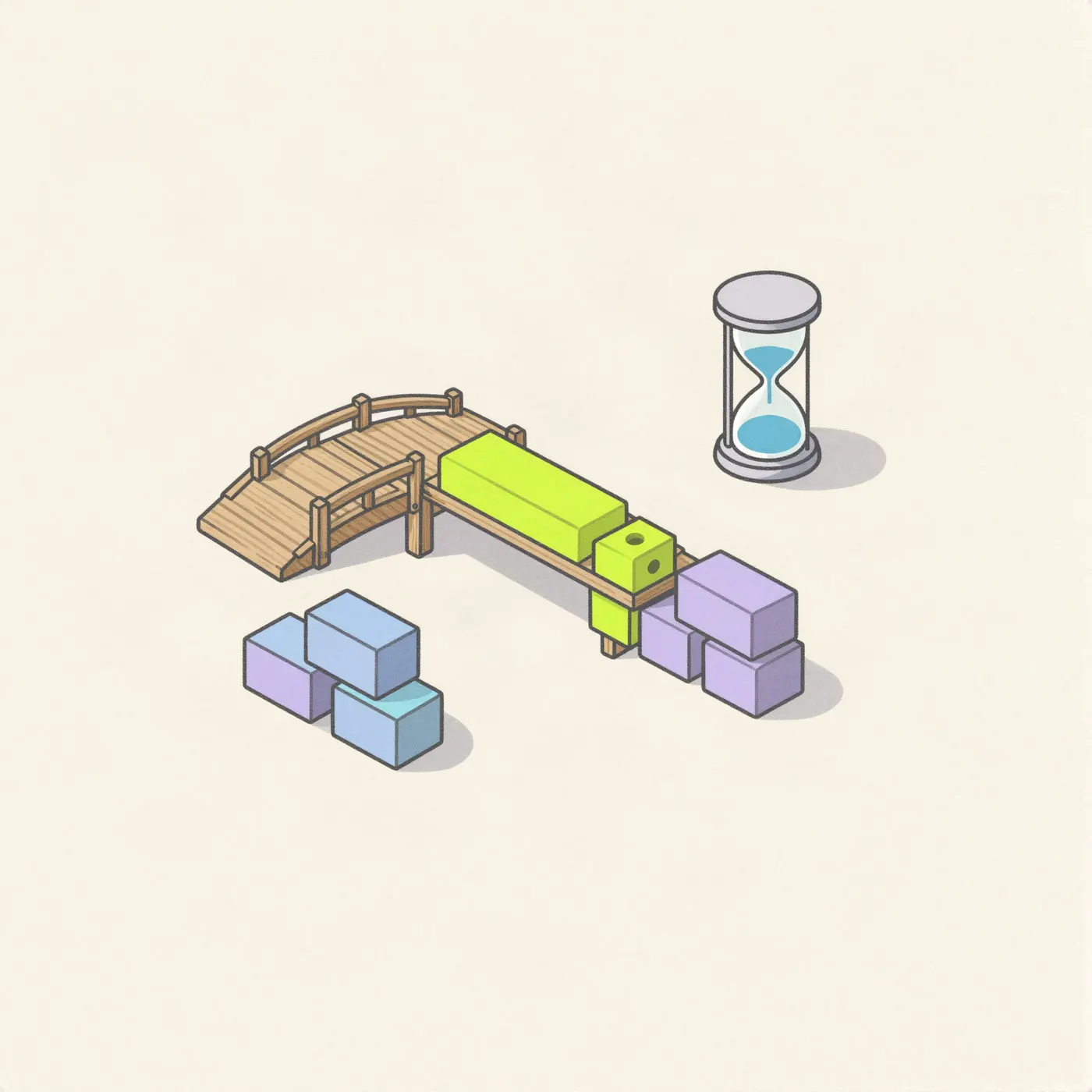
A bricklayer sits a practical test: a drawing of a short wall with a pier, and six hours. The judges measure only what the drawing shows, so a decorative band nobody asked for earns nothing. Before laying a brick she sorts the drawing into what must stand, what she adds if time allows and what she will not build. She takes one bay to full height, jointed and brushed, before starting the next, because a judge can only measure a finished bay. When the whistle goes, the trowel goes down and the judges mark what stands.
| In the bricklaying test | In the take-home |
|---|---|
| The drawing | The task sheet |
| A decorative band nobody drew | An extra feature the sheet does not ask for |
| Must stand, if time allows, will not build | Must, should and won't |
| One bay finished to full height before the next | One must item complete before the next |
| The whistle | The stated time |
Breaks down when: the whistle enforces the time, while a take-home's clock is yours to keep and to report. Wrong inference: “the reviewers will notice if I run over, so I need not say.” A judge also marks the wall alone, while a reviewer reads your notes on what you left out.
In real terms: at each hour mark, count the must items that are complete, not the ones that are started.
Examples, run for real
EXH-2300 is a synthetic practice run of the ExamHall proctor-dashboard take-home: 4 hours, three required features (the candidate list with each status, a filter by status, live status changes), and an optional detail panel. The candidate built every route, then two extras of her own, then every screen, the README and the tests. The re-run, a week later, is MR !2600.
EXH-2300 · box 240 min · order: setup, 3 routes, dark mode, CSV export, 3 screens, README, 3 tests
  at 240 min: must items complete 0 of 3 · extras working 2 (CSV export, dark mode)
  worked 270 min · README says "about 4 hours" · left out listed: none
MR !2600 · sort: must 3 · should 1 (detail panel) · won't 2 (CSV export, dark mode)
  plan: setup 15 + musts 170 + README 20 = 205 of 240 · should budget 35 · detail panel 30 fits
  complete: list at 70 · filter at 110 · live status at 185 · detail panel at 215 · README at 235
  worked 235 min (3 h 55 min) of 240 · README says "3 h 55 min of 4 h" · left out listed: CSV export, dark mode
The first run put its tests last, behind two extras and the README. At 240 minutes no required feature had its test, so none was complete, while both extras worked. The README then claimed about four hours for 270 minutes of work, and listed nothing as left out.
In the re-run the sort comes first: the sheet's three features are musts, the optional panel is a should, and the two extras are won'ts, written down. Setup and the README are budgeted inside the box, so the panel is added only because its 30 minutes fit the 35 left. Each feature is finished, test included, before the next starts, so a complete feature exists from minute 70. The README reports the real 235 minutes and names the two extras it left out.
The script replays the author's fixture logs; it does not judge code quality or what a real reviewer would score.
Picture it
Try it
Answer first, then check. Nothing is saved.
Question 1 of 5
A chat take-home allows 3 hours. The candidate's plan: setup 15 min; must items: send a message 30 min, the message list 25 min, mark as read 30 min; the README 20 min; should items, which the sheet marks optional, taken in this order, each one only if it still fits: a typing indicator 35 min, then message search 25 min. The clock now reads 1 h 40 min. Setup, sending and the message list are done and tested; mark as read and the README are still ahead.
Which should items can still fit inside the 3 hours?
Question 2 of 5
A 3-hour chat take-home has three must items: send a message, the message list, mark as read. Each needs an API route (20 min), a screen (30 min) and a test (send 10, list 15, mark-read 20 min). After 15 min of setup the candidate builds all three routes, then all three screens, then the three tests in that order.
When the 3 hours end, how many must items are complete?
Question 3 of 5
A 3-hour chat take-home. At 2 h 20 min the three must items worked and their tests passed, and the candidate began message search, which the sheet does not ask for. At 2 h 45 min search is half built, and with its code in, the app crashes on start. Fifteen minutes remain.
What should she submit?
Question 4 of 5
A candidate's work log for a 3-hour chat take-home, all on one Saturday: 10:00–10:20 project setup; 10:20–12:05 the three must items; 12:05–12:50 lunch away from the desk; 12:50–13:40 tests and fixes; 13:40–14:05 the README.
At the review, the engineer asks, “How long did you spend on this?” Which answer does the log support?
Question 5 of 5
A 3-hour chat take-home's task sheet says: “Users send messages to a conversation and see them in order, newest at the bottom. Each conversation shows how many of its messages are unread. A message being sent must not be lost if the page reloads.” Before coding, a candidate drafts her must list.
Which of these draft lines is not a must?
Go deeper
Pro tip
Put the box's end time in your calendar with a reminder 45 minutes before it. When the reminder goes off, start no new item.
Related lessons
- Related: The three AI failure modes
- Related: Scoping under uncertainty
- Related: Problem framing
- Related: Requirements and quantified non-functional requirements
- Related: Narrating while you code
- Related: The README as a design doc
- Related: Senior quality signals in a take-home
- Related: The trade-off sentence: what it gives, what it costs, why you'd pick it, when you'd switch
Checked against the tools and docs as of 2026-10-01.